

This paper was drafted for a class assignment on complex systems but slightly modified to fit the format of this blog. As political polarization is a phenomenon I’ve always been interested in studying, I’m sharing this with you all in the hopes that you glean some new insight into today’s political landscape and specifically the causal factors behind extreme polarization.
Introduction
The two-party system in the United States has been a foundational aspect of government, with roots tracing back to the 18th century. Over time, names have changed — we no longer use the terms “Federalist” or “Democratic-Republican” — but the idea has remained, solidifying into the two parties prevalent today: the Democratic and Republican Parties. Though the balance between these two has been credited with mitigating the risk of a one-party state and totalitarian rule, the two-party system has risks of its own, pointed out even years before its rise. In Federalist #10, published in 1787, James Madison wrote that it was the nature of humans to disagree more than agree and self-sort into factions, or what we now consider political parties (Madison, 1787). As a result, George Washington warned in his Farewell Address (1796), national goals would be overshadowed by parties attempting to stay in power. So critical was partisanship — allegiance to one party — that he claimed it to be the most urgent threat to the nation. Written in 1796, this is still relevant today in light of the polarization that has grown in the United States in recent years.
The Ideological Spectrum
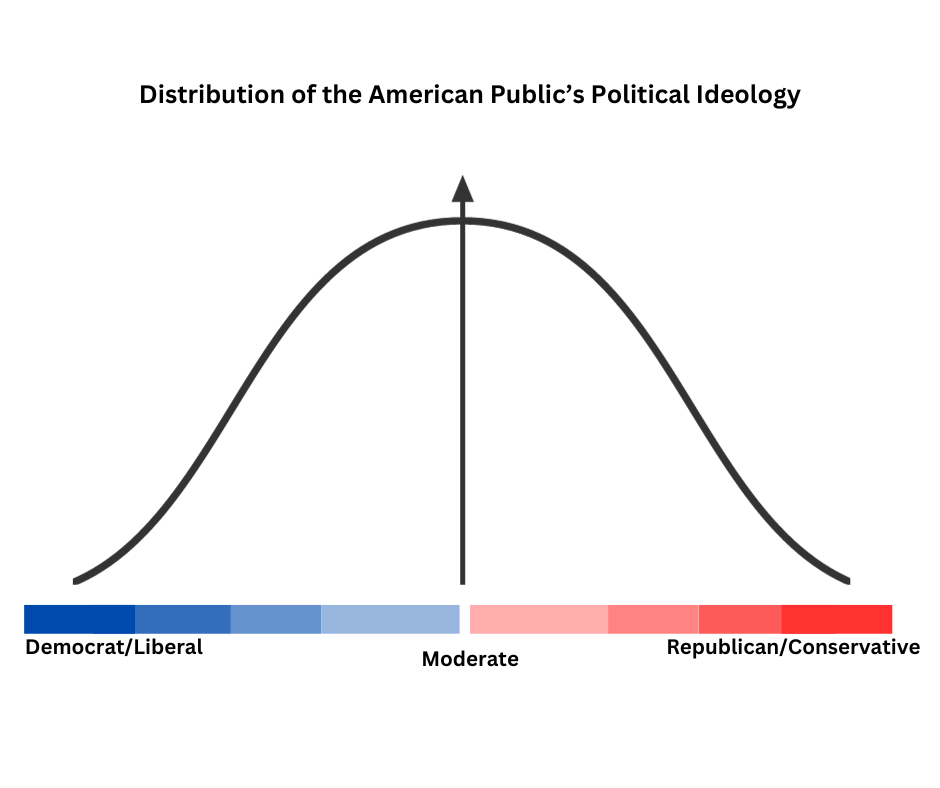
This figure shows the American public’s ideological distribution based on analyses done by Yang et al. (2020). The R² of the Gaussian fit is 0.74.
Polarization today can be visualized on an ideological spectrum. Nuances vary between individual members, but the Democratic Party generally leans to the left with liberal ideology, while the Republican Party leans to the right with conservative ideology. This divide influences policy on social, economic, and political issues; for example, Democrats support more government intervention in the economy and establishing social welfare programs, while Republicans advocate for less government control, supporting free market economics and regulated taxes.
While politicians on both sides hover toward extremes, the majority of the American public holds moderate political views — something that has remained unchanged since WWII. Data from the American National Elections Studies (ANES)’s annual survey shows that public ideology has an unimodal distribution, its peak around the moderate position, and can be approximated with a Gaussian distribution as shown in the diagram (Yang et al., 2020).
So why there is extreme polarization in the United States when both parties have their roots in the same Constitutional values, work together and make compromises to run the federal government, and represent the interests of the people, the majority of which have moderate — not extreme — ideologies?
The Causes of Political Polarization
It is difficult to pinpoint a cause of political polarization because there are many contributing factors: the pluralistic, zero-sum-game electoral system, the rising interconnectedness between individuals, and the affinity for people to become emotionally polarized — known as affective polarization.
Because winning an election in the United States is determined by winner-takes-all districts in which a party can win without necessarily holding a majority, two competitors form, each trying to obtain more than half of the votes, facilitating the rise of the two-party system (Frymer, 2011). This phenomenon is known as Duverger’s Law and incentivises each of the two major parties to differentiate and present themselves in a way that appeals to the average voter (Riker, 1982).
Still, there are many ways a party can go about this. As previously mentioned, the majority of Americans are politically moderate; thus, it may be intuitive to conclude that the best approach would be to campaign in accordance with these interests. However, this makes the assumption that individuals exist and make decisions independent of others, whereas in reality, there are high levels of interactions and influence between them. This social network can be mapped using the below diagram:
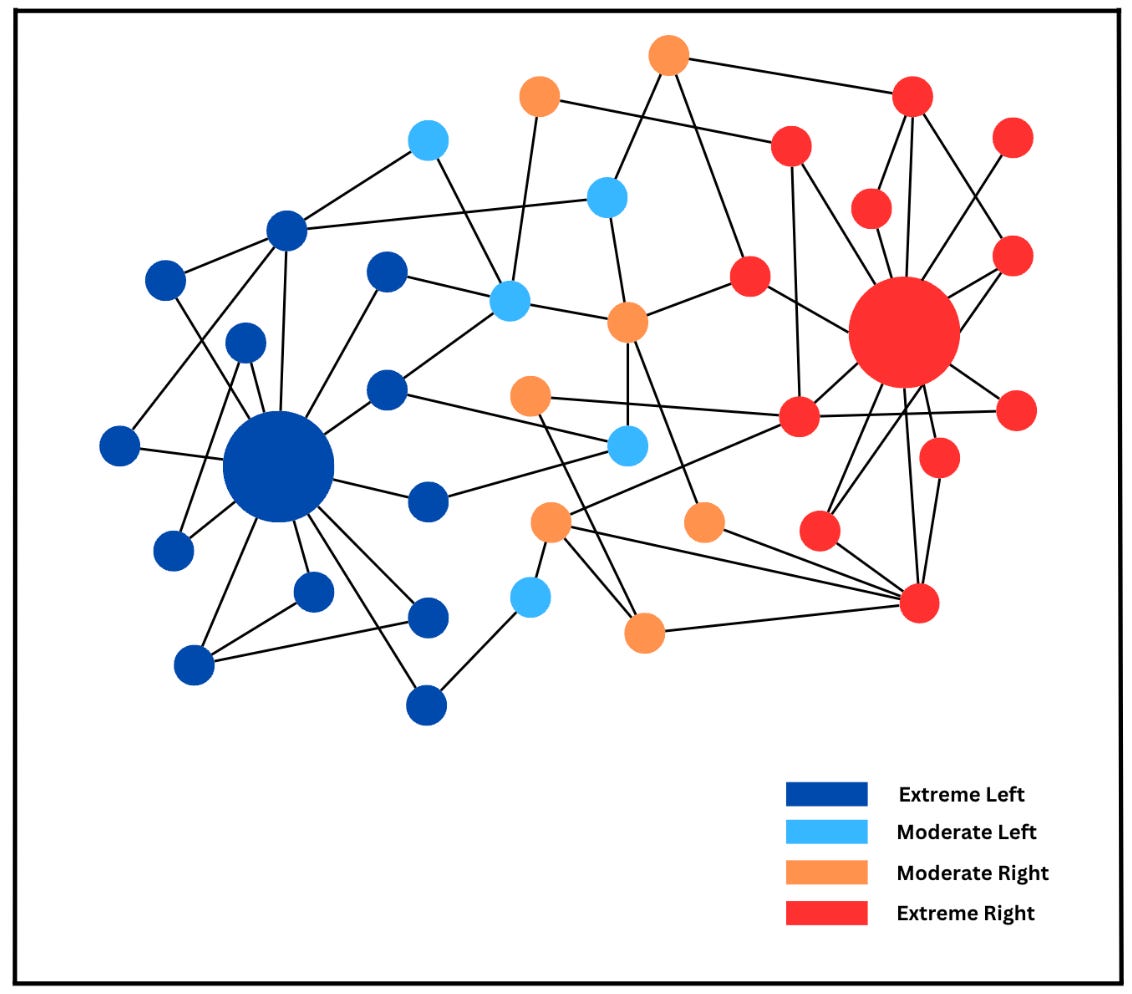
This figure maps the interaction between nodes relative to their position in the network.
Nodes are color-coded by ideology and sized by political status. We focus on two statuses: political leaders (large circles) and private citizens (small circles). Edges are defined as mutual interactions between individuals, examples being following each other on social media or being acquaintances in real life.
As shown, the two political leaders have direct connections with individuals who lean toward ideological extremes, but less so with those who have moderate views. Deductively, we can state that individuals with extreme ideologies cluster around the two political figures. Within these clusters, homogenized ideology forms (Yang et al., 2020): camaraderie tightens members who unite around common values, ideologies, and policies. According to Kleinfeld (2023), this curates an “us vs. them” mindset and vilifies the other party, fueled by misbeliefs and casting demographic stereotypes — for example, all Republicans are old, rich businessmen, while Democrats are young unionists. This is consistent with the findings of Talisse (2022) who proposed that perception gaps form echo chamber environments where people only interact with those who share their existing opinions, themselves becoming more extreme and intolerant in the process. This degree of intolerance is known as affective polarization, and thus, a reinforcing feedback loop is formed: as hate grows, the less each member is willing to interact with the opposing party, limiting opportunities for misunderstandings to be resolved.
This type of polarization cannot be explained by looking solely at individuals’ properties in an isolated system because it arises out of interactions with others. When studying at this higher level of analysis, we can find patterns such as clustering, as well as how one’s position in the network contributes to who and how far they can influence. This also justifies why extreme ideologies work as a strategy in a pluralist voting system: as individuals, the average voter does not have the same ideological stance as politicians, but implicit pressure from other party members who do support extreme positions often leads them to self-identify with and vote for these extremes.
None of these causes are sufficient to cause polarization on its own accord but are individually necessary. The electoral system depends on interconnectedness to appeal to the moderate voter, while affective polarization explains why groups react with hostility toward the opposing party. Polarization of this magnitude is unlikely to be brought about in the absence of these three factors.
Implications
With these factors considered, it’s possible to create a visualization that represents the current state of polarization in the United States:
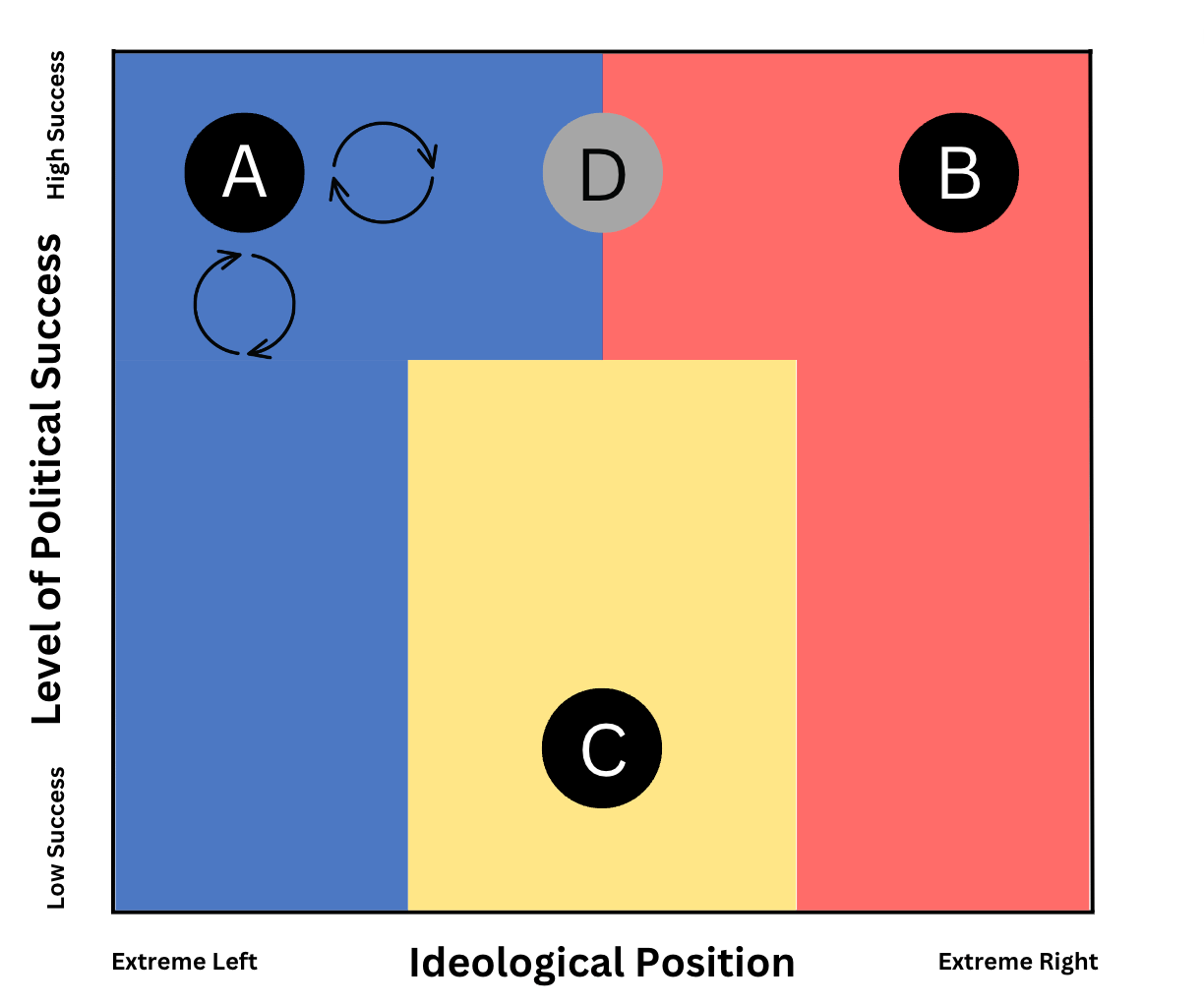
This figure shows the system’s stable states with respect to a politician’s ideological position and level of success measured by the number of elections won.
In this phase space, the two dimensions are defined as a politician’s ideological position (left to right), and level of political success. This system tends toward three stable states:
A: An extreme left politician with high success
B: An extreme right politician with high success
C: A moderate politician with low success
It is unlikely that a state will exist beyond these three basins of attraction, as it will be unstable, and prone to transitioning back, as shown by the arrows around A. The reasoning behind this has been explained in the previous section: Duverger’s Law, high interconnectedness, and affective polarization. This creates a system where extreme politicians are rewarded with success, while moderate politicians are pressured to adopt extreme ideologies.
As such, there are critical points in the system where it is possible for the system to shift into a different state — namely, when a party shifts toward moderate ideology, or begins to experience a smaller or larger level of political success. At these critical, unstable points, it is possible for two types of events to occur, which will shift the system into a new state. The first, random noise, are events that are constantly active in the background of the system. Fluctuations in policy debate outcomes and new legislation can push a politician to be more liberal or conservative, and temporarily shift the system. External shocks are larger events that have a higher probability of forcing the system into a new state. For example, war will likely forge a new national identity, breaking the echo chamber and bridging perception gaps. This process, as described by Eucken (1918) in the context of WWI, united Germany against a common enemy, the need of the nation transcending ideological divides.
Similarly, in the United States, it is likely that in case of war, both parties will reconcile ideological differences, creating a new attractor — Attractor D — in the process. However, this will be a temporary state; once the external threat subsides, the system will gradually shift back to the existing attractors.
Conclusion
These analyses are not exhaustive nor comprehensive, but do provide brief insight into understanding the phenomena of political polarization; however, as with all complex systems, further analysis can reveal more causes, some of which may be necessary, sufficient, or both, to bring about the extent of polarization in the United States today.
References
Eucken, R. (1918.). The Moral Forces of War. https://courses.edx.org/asset-v1:KULeuvenX+GRAPHx+3T2015+type@asset+block/Module2_A_Base.pdf
Frymer, P. (2011). Debating the Causes of Party Polarization in America. California Law Review, 99(2), 335–349. http://www.jstor.org/stable/23018604
Washington’s Farewell Address - U.S. senate. (n.d.). https://www.senate.gov/artandhistory/history/resources/pdf/Washingtons_Farewell_Address.pdf
Kleinfeld, R. (2023). Introduction: Five Facts About Polarization in the United States. In Polarization, Democracy, and Political Violence in the United States: What the Research Says (pp. 1–7). Carnegie Endowment for International Peace. http://www.jstor.org/stable/resrep53058.4
Madison, J. (2008a). The federalist papers no. 10. Avalon Project - Documents in Law, History and Diplomacy. https://avalon.law.yale.edu/18th_century/fed10.asp
Riker, W. H. (1982). The Two-Party System and Duverger’s Law: An Essay on the History of Political Science. The American Political Science Review, 76(4), 753–766. https://doi.org/10.2307/1962968
Talisse, R. B. (2023, September 12). Not all polarization is bad, but the US could be in trouble. The Conversation. https://theconversation.com/not-all-polarization-is-bad-but-the-us-could-be-in-trouble-173833
Washington’s Farewell Address - U.S. senate. (n.d.-a). https://www.senate.gov/artandhistory/history/resources/pdf/Washingtons_Farewell_Address.pdf
Yang, V. C., Abrams, D. M., Kernell, G., & Motter, A. E. (2020, September 1). Satis Cing Dynamical Model. https://arxiv.org/pdf/2008.05661.pdf
Good analysis